

Payroll Risks That Startups Often Overlook
In many startups, payroll begins as a simple task: tally employee hours, process payments, and move on. However, as a company grows, what was once a routine administrative function can evolve into a significant operational challenge. Complicated pay structures, state-specific tax regulations, and compliance requirements can quickly transform payroll into a high-risk area.
Small errors may seem insignificant, but they can have outsized consequences. Late or incorrect payments can erode trust among employees, while missed tax filings or compliance lapses can result in financial penalties and regulatory scrutiny. Startups and small businesses often operate with lean teams, meaning every misstep consumes time and resources that could otherwise drive growth.
Consider a startup that expands into multiple states without updating its payroll processes. A single miscalculated tax withholding can trigger fines in multiple jurisdictions, causing not just financial loss, but also reputational damage. Such scenarios underscore that payroll is not merely a back-office function; it is a critical operational foundation.
Content
- Payroll Risks That Startups Often Overlook
- Automation as a Risk Mitigation Strategy
- The Hidden Costs of Manual Payroll Systems
- Human Expertise Remains Indispensable
- Payroll as a Strategic Business Function
- Assessing Payroll and HR Readiness
- Conclusion: Balancing Technology with Human Expertise
- FAQs: Automating Payroll for Startups and Small Businesses
Automation as a Risk Mitigation Strategy
Automating payroll is more than a way to save time—it is a mechanism for mitigating risk. Automated systems ensure accurate, consistent payroll processing and provide real-time visibility into labor costs, overtime allocations, and workforce distribution. These systems also embed compliance controls that adapt to changes in federal and state regulations, reducing the chance of costly mistakes.
Startups with remote or multi-state teams face particularly complex payroll challenges. While manual processes may suffice for small teams, they quickly become fragile under growth pressures. Automation offers reliability, ensuring that payroll remains accurate and compliant even as the organization scales.
For example, WFX Fire, Lock & Security, a small service company with locations in Maryland and Pennsylvania, leverages automated tax setups to handle multi-state payroll. The system removes manual calculation burdens while still allowing a dedicated support representative to manage special scenarios, such as prevailing wage jobs, ensuring both efficiency and regulatory compliance.

The Hidden Costs of Manual Payroll Systems
Many startups initially rely on spreadsheets or simple payroll tools. While these may appear economical, they introduce hidden costs. Manual payroll processes are prone to calculation errors, require extensive labor for audits, and consume significant time as teams grow. The administrative burden can divert attention from core business objectives and negatively affect employee satisfaction.
Community Living, Inc., a nonprofit organization serving over 150 clients with a workforce of more than 200 employees, demonstrates these challenges. Managing payroll for roles with variable hours, overtime, and specialized pay requires precision. Automation streamlines these processes while allowing a human expert to address exceptions, ensuring accurate pay and regulatory compliance.
Human Expertise Remains Indispensable
Technology alone cannot replace the judgment and knowledge of experienced HR and payroll professionals. Human oversight is crucial for interpreting complex labor laws, managing unique compensation structures, and adjusting processes to reflect organizational changes.
At both WFX and Community Living, automated systems provide speed and consistency, but human expertise ensures accuracy and compliance in nuanced scenarios. Payroll teams interpret complex rules, troubleshoot exceptions, and guide organizational decisions that technology alone cannot fully anticipate.
Payroll as a Strategic Business Function
Viewing payroll as a strategic function rather than a routine task offers tangible benefits. Accurate and timely payroll fosters employee trust, improves operational transparency, and strengthens compliance confidence. Integrating payroll with HR systems, timekeeping, and learning management platforms creates a holistic people strategy that can scale with business growth.
For example, Community Living integrates payroll with timekeeping and learning management systems to track labor allocations and staff certifications. This integrated approach not only ensures compliance but also provides leadership with actionable insight into workforce needs, enabling smarter staffing decisions.

Assessing Payroll and HR Readiness
Startups and small businesses should regularly assess the maturity of their payroll and HR processes. Key questions include:
- Are payroll and HR processes fully automated, or do manual steps persist?
- Are compliance requirements consistently met across all locations and employee types?
- Do internal teams have access to subject-matter experts for complex payroll or HR scenarios?
By answering these questions, organizations can proactively identify gaps and reduce operational risks. Advanced planning and evaluation ensure scalability and provide the foundation for confident workforce management.
Conclusion: Balancing Technology with Human Expertise
Automation and technology are critical enablers for efficient, compliant payroll. Yet, human expertise remains indispensable. The most effective payroll strategies blend robust automation with expert guidance, enabling businesses to minimize risk, maintain employee trust, and focus on growth.
Organizations that treat payroll as a strategic function position themselves for sustainable growth, operational stability, and enhanced workforce engagement. Startups and SMBs that adopt this approach can confidently scale while keeping both employees and compliance requirements satisfied.

Smarter Payroll Starts with Knowing Your Risks
Automating payroll helps you scale, but gaps in your HR strategy can still create risk. Take our HR Risk Assessment to uncover issues, improve compliance, and build a stronger foundation for growth.
Take the HR Risk Assessment →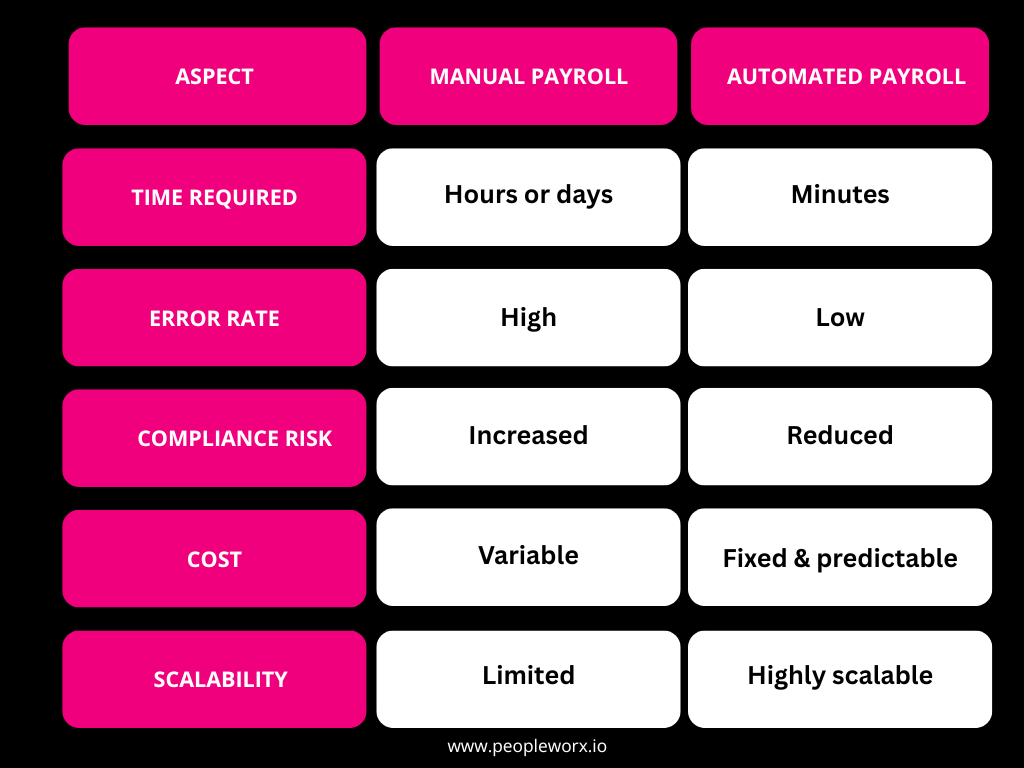
FAQs: Automating Payroll for Startups and Small Businesses
Why is payroll high-risk for startups?
Payroll grows in complexity as startups scale. Multi-state employees, variable schedules, and regulatory compliance requirements increase the likelihood of errors, which can affect employee trust and lead to fines.
How does automation reduce payroll risk?
Automated systems standardize calculations, provide real-time reporting, and incorporate compliance controls, minimizing errors and ensuring regulatory adherence.
Are manual payroll systems sufficient for scaling companies?
Manual systems may work for very small teams, but as headcount and complexity grow, they introduce inefficiencies, compliance gaps, and increased labor demands.
What role does human expertise play in automated payroll?
Human experts interpret complex labor laws, handle exceptions, and make judgment calls that technology alone cannot, ensuring accuracy and compliance.
How can multi-state payroll compliance be managed effectively?
Automation paired with expert guidance allows businesses to handle different tax jurisdictions, diverse pay rules, and special wage scenarios without overburdening internal staff.
Why should payroll be treated as a strategic function?
Strategic payroll enhances employee trust, retention, operational transparency, and compliance. Integrating payroll with HR and learning systems creates a holistic people strategy that scales with growth.
How can SMBs evaluate their payroll and HR readiness?
Organizations should assess automation levels, consistency in compliance, and access to subject-matter experts. This evaluation helps identify gaps and prepare for scalable, compliant operations.
Streamline payroll, stay compliant across multiple states, and reduce operational risk with scalable payroll and HR solutions.
If you need help with workforce management, please contact PeopleWorX at 240-699-0060 | 1-888-929-2729 or email us at HR@peopleworx.io