
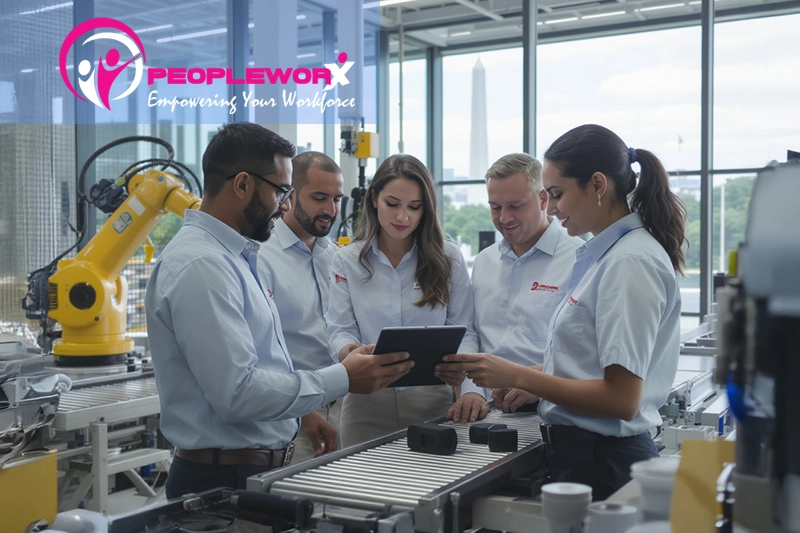
Across Washington, D.C., Maryland, and Northern Virginia, manufacturers are facing an increasingly complex talent environment. Job openings remain difficult to fill. Experienced workers are retiring. Automation and digitization are reshaping skill requirements faster than training pipelines can replenish them. And small to mid-sized manufacturers (SMBs) often feel they are competing against larger organizations with more robust recruiting budgets and brand recognition.
But framing this solely as a “talent shortage” misses the deeper issue.
The manufacturing skills gap is fundamentally a workforce strategy issue that includes the one that sits squarely within HR leadership, operational infrastructure, and long-term organizational planning.
For SMB manufacturers, the question is not simply, “How do we find more workers?” It is:
- How do we create a workplace that attracts, develops, and retains the right talent?
- How do we reduce friction in payroll, compliance, onboarding, and training?
- How do we build systems that scale with growth instead of creating risk?
The organizations that answer those questions strategically rather than tactically will outperform competitors regardless of size.
Understanding the Modern Skills Gap in Manufacturing
The term “skills gap” is often used broadly, but in practice it reflects several converging forces:
1. Accelerated Technology Adoption
Modern manufacturing environments rely increasingly on automation, data systems, robotics, and software-driven workflows. Even entry-level roles now require technical literacy, adaptability, and comfort with digital interfaces.
However, workforce development programs often lag behind these technological shifts. That gap leaves employers needing candidates who are both technically competent and capable of continuous learning that is a combination in high demand across industries.
2. Demographic Pressure and Knowledge Drain
A significant portion of skilled tradespeople and experienced operators are nearing retirement. When they exit, organizations lose more than labor capacity, as well as, they lose institutional knowledge, process intuition, and informal mentorship structures.
Without intentional knowledge transfer and internal development programs, that expertise disappears.
3. Heightened Competition for the Same Talent Pool
Manufacturers are not just competing with other manufacturers. Skilled candidates are also being recruited by logistics companies, infrastructure firms, tech-enabled service providers, and even remote-friendly industries offering alternative career paths.
Large employers often compete on compensation and benefits scale. SMBs must compete differently through agility, culture, growth opportunity, and operational stability.

Why Workforce Infrastructure Is the Real Differentiator
When organizations struggle with hiring, the instinct is often to focus externally: post more job ads, increase compensation, engage recruiters. While those tactics have value, they overlook a powerful internal lever which is the workforce infrastructure.
In today’s labor market, candidates evaluate more than wages. They evaluate reliability, professionalism, and long-term opportunity. And much of that evaluation is shaped by HR execution.
Consider the signals candidates and new hires receive:
- Is onboarding organized and efficient?
- Are payroll processes accurate and consistent?
- Is time tracking transparent?
- Are compliance practices professional and predictable?
- Are training pathways visible and accessible?
If any of those systems feel chaotic, outdated, or error-prone, candidates interpret that instability as risk.
For hourly and skilled trade workers in particular, payroll accuracy is foundational. An error in overtime calculations, prevailing wage classifications, shift differentials, or multi-state tax withholding does more than create inconvenience, as well as, it erodes trust.
Workforce infrastructure is not administrative overhead. It is part of employer brand credibility.

Competing Strategically as a Small or Mid-Sized Manufacturer
While SMB manufacturers may not match large enterprises dollar for dollar, they possess advantages that are often underleveraged. The key is aligning those advantages with disciplined HR strategy.
1. Operational Stability as a Retention Tool
Employees stay where systems work.
Organizations that reduce payroll errors, automate compliance updates, and streamline timekeeping free up leadership attention for engagement and development. When managers are not constantly reacting to administrative fires, they can coach, mentor, and plan.
Stability builds confidence. Confidence supports retention.
2. Structured but Agile Skills Development
Upskilling must become continuous rather than episodic.
SMBs can implement scalable, practical development approaches such as:
- Cross-training across production lines
- Certification tracking systems
- Micro-learning modules aligned with equipment or safety upgrades
- Clear competency progression frameworks
The goal is not to replicate enterprise-level L&D departments. It is to create visible growth pathways that signal long-term opportunity.
When employees see progression, they are less likely to leave for marginal pay increases elsewhere.
3. Authentic Employer Value Proposition
Larger employers may offer brand recognition. Smaller manufacturers can offer visibility and impact.
In many SMB environments:
- Employees work directly with leadership.
- Contributions are visible and meaningful.
- High performers can advance faster.
- Culture feels personal rather than bureaucratic.
However, these advantages must be intentionally communicated and supported by strong HR processes. Culture cannot compensate for compliance failures or payroll inaccuracies.
4. Compliance Confidence as Competitive Advantage
Multi-state operations, prevailing wage requirements, overtime rules, ACA obligations, and industry-specific regulations create significant complexity. Compliance missteps carry financial and reputational risk.
Forward-thinking manufacturers treat compliance as a proactive discipline rather than a reactive burden. They invest in systems and expertise that ensure wage rules, tax setups, and reporting requirements are handled correctly the first time.
This approach protects margins and reinforces operational professionalism that is both internally and externally.
From Reactive Hiring to Proactive Workforce Planning
The most resilient manufacturers move beyond filling open positions and toward long-term workforce planning.
That includes:
- Mapping retirement risk and succession needs
- Identifying high-potential internal talent
- Forecasting skill requirements based on technology investments
- Building relationships with community colleges, trade schools, and workforce development boards
- Creating apprenticeship or internship pathways
Workforce planning aligns HR with operational strategy. When HR is positioned as a strategic partner rather than an administrative function, organizations gain competitive agility.

It’s Not Just a Hiring Problem. It’s an HR Risk Problem.
The D.C. manufacturing skills gap is often rooted in HR strategy, not hiring alone. Take the HR Risk Assessment to spot hidden workforce risks and see where your strategy may need strengthening.
Start the Assessment →Frequently Asked Questions
What is driving the manufacturing skills gap in the D.C. region?
The gap reflects multiple pressures: retirement of experienced workers, accelerated technology adoption, and intensified competition across industries for technically capable talent. Regional economic growth compounds the issue by increasing overall labor demand.
Why do small and mid-sized manufacturers struggle more visibly with hiring?
SMBs often operate with lean HR teams and legacy systems that were sufficient at a smaller scale but become strained during growth. When onboarding, payroll, and compliance processes lack automation or oversight, administrative friction compounds hiring challenges.
How does payroll accuracy impact retention?
Payroll is foundational to employee trust. In manufacturing environments with overtime, prevailing wage rules, and shift differentials, calculation errors can quickly undermine morale. Accurate, timely pay signals organizational competence and respect for employees’ work.
What role does HR technology play in closing the skills gap?
Technology alone does not solve the gap, but integrated systems that connect onboarding, timekeeping, payroll, benefits administration, and learning management reduce operational friction. When data flows seamlessly, leadership gains visibility into labor allocation, certification status, overtime trends, and compliance exposure at the same time enabling the smarter workforce decisions.
How should manufacturers approach compliance risk?
Compliance should be treated as an ongoing management discipline, not an annual review exercise. Multi-jurisdiction tax rules, ACA reporting, labor allocations, and wage classifications require consistent oversight. Proactive audits and risk assessments help identify vulnerabilities before they become liabilities.
Is workforce development realistic for smaller organizations?
Yes indeed, when structured intentionally. Smaller organizations can implement targeted cross-training, certification tracking, and internal mentorship programs without large budgets. The key is consistency and alignment with operational goals.
The Strategic Imperative
The D.C. manufacturing skills gap is unlikely to resolve in the near term. Demographic and technological trends suggest continued pressure.
However, the manufacturers that thrive will not necessarily be the largest rather they will be the most disciplined in how they manage their people infrastructure.
Workforce stability, compliance rigor, structured development, and operational transparency are no longer back-office concerns. They are competitive differentiators.
For leaders evaluating the strength of their current HR foundation, beginning with an objective HR Risk Assessment can provide clarity on exposure areas and operational gaps. Additional practical guidance on workforce strategy, compliance, and HR best practices for SMBs is available through our dedicated HR resource center.
Because in a labor market defined by scarcity and competition, strong businesses are built on strong workforce systems and strong workforce systems begin with intentional HR leadership.
The manufacturing skills gap is rarely just about hiring. It’s often about compliance exposure, workforce structure, and leadership blind spots that surface too late.
If you’re navigating workforce risk, documentation gaps, or strategic HR uncertainty, start with practical guidance.
If you need help with workforce management, please contact PeopleWorX at 240-699-0060 | 1-888-929-2729 or email us at HR@peopleworx.io