
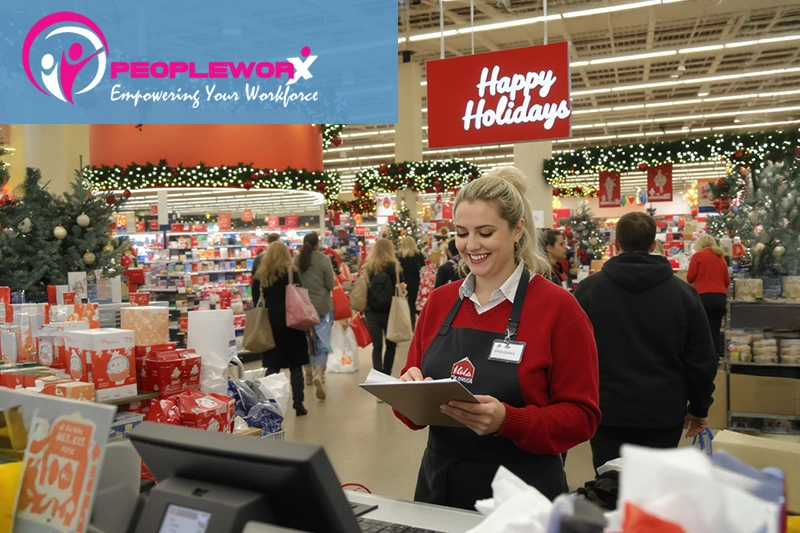
For retailers across the DMV, the holiday season creates a familiar kind of pressure. Customer traffic rises quickly, store hours often expand, managers need coverage with little margin for delay, and leadership is expected to move fast without losing control of the employee experience. In that environment, holiday hiring is often treated as an operational necessity: post openings, fill shifts, get people on the schedule, and keep the season moving.
But that mindset misses a larger truth. Seasonal hiring is not just a recruiting challenge. It is an HR strategy issue.
For retail employers in Washington, D.C., Maryland, and Virginia, holiday hiring sits at the intersection of workforce planning, compliance, manager readiness, onboarding discipline, payroll accuracy, and employee retention. And while the jobs themselves may be temporary, the risks associated with poor hiring practices are not. A rushed process can lead to wage and hour mistakes, inconsistent onboarding, scheduling confusion, poor employee performance, and preventable turnover at the exact moment the business can least afford disruption.
That is why the most effective retail employers do not approach holiday hiring as a short-term staffing sprint. They treat it as a test of whether their people operations can hold up under pressure.
Content
- In the DMV, Holiday Hiring Is More Complex Than It Looks
- Seasonal Employees Still Require Real HR Structure
- The Holiday Season Exposes Weaknesses That Already Exist
- Onboarding Should Be Treated as a Performance Tool
- Seasonal Hiring Can Become a Long-Term Talent Strategy
- Scheduling Discipline Often Determines Whether the Season Feels Controlled or Chaotic
- Seasonal Hiring Is Also a Talent Strategy Opportunity
- Thoughtful Holiday Hiring Reflects Organizational Maturity
- The Best Time to Strengthen Holiday Hiring Is Before the Rush Begins
- FAQs: DMV Holiday Hiring for Retail Employers
In the DMV, Holiday Hiring Is More Complex Than It Looks
One reason seasonal hiring deserves a more strategic lens is that the DMV is not a simple employment market. It may feel like one interconnected region from a labor perspective, but employers are still operating across distinct jurisdictions with different requirements, expectations, and practical realities.
Retailers in this region often recruit from the same talent pool, even when they have locations in different states or in the District. A worker may live in Maryland, interview for a store in Northern Virginia, and later pick up hours at a D.C. location. A leadership team may think of itself as running one retail operation, but the employment framework around that operation is not always uniform. That creates added complexity at the very moment seasonal hiring tends to move fastest.
Why the Regional Labor Market Creates More Complexity
This is where employers can get into trouble. When the emphasis is entirely on speed, important distinctions between locations, policies, and manager practices can be overlooked. The result is often inconsistency. One store may be onboarding thoroughly while another is improvising. One manager may be communicating scheduling expectations clearly while another handles attendance and timekeeping informally. Payroll may technically be centralized, but errors often begin at the store level when managers are not aligned on hours, breaks, approvals, or documentation.
None of those issues feel significant in isolation. During the holiday season, however, they have a way of compounding.
Why Employers Need to Think Beyond Headcount
What starts as a simple need for extra coverage can become a broader operational problem if the business has not prepared for how seasonal hiring interacts with the rest of the employee lifecycle. That is why smart employers widen the conversation early. They are not just asking how many people need to be hired. They are asking whether managers are equipped, whether processes are consistent, and whether the organization is ready to absorb a temporary workforce without creating unnecessary friction.
Seasonal Employees Still Require Real HR Structure
One of the most common mistakes employers make with holiday hiring is assuming that temporary employment can be managed more casually than permanent hiring. Because seasonal workers may only be in the business for a matter of weeks or months, leaders sometimes lower the standard around onboarding, communication, documentation, and manager follow-through. The assumption is that there is not enough time to do it perfectly, so doing it informally is enough.
In practice, that shortcut usually costs more than it saves.
Seasonal employees still need a clear understanding of what they are being hired to do, what standards they will be held to, how to track time, how scheduling works, where to go with questions, and what the company expects from them on attendance, conduct, and performance. They still need to be hired and paid correctly. They still shape the customer experience. And in many cases, they are working during the most visible and demanding period of the retail year.
Temporary Does Not Mean Informal
When employers fail to provide that structure, the effects show up quickly. New hires may be uncertain about priorities. Managers spend more time answering avoidable questions. Scheduling disputes become more frequent. Timekeeping errors increase. Team morale suffers when some employees receive clearer direction than others. Customers notice the impact even if they do not know the cause.
Structure Matters More When Ramp-Up Time Is Short
The real issue is not that seasonal employees are temporary. It is that they often have less time to get up to speed, which makes structure more important, not less.
A strong holiday hiring process recognizes that reality. It respects the compressed timeline of seasonal work and responds with clarity, consistency, and preparation. That is what allows short-term employees to become productive faster while reducing the burden on store leaders who are already operating in a high-pressure environment.

The Holiday Season Exposes Weaknesses That Already Exist
Another reason to view seasonal hiring through a thought-leadership lens is that the holiday season rarely creates entirely new HR problems. More often, it exposes existing weaknesses that were already present in the business.
If scheduling is typically loose, it becomes chaotic during peak season. If managers are not aligned on policies, the inconsistency becomes more visible when more employees are added quickly. If onboarding is usually dependent on whichever manager happens to be available, that weakness becomes harder to ignore when multiple hires start at once. If payroll inputs are already vulnerable to error, the increased volume of hours, shift changes, and overtime pressures makes those cracks wider.
Seasonal Hiring as an Operational Stress Test
This is an important shift in perspective for business leaders. Seasonal hiring should not be viewed only as a year-end challenge to survive. It can also be treated as an operational stress test. It reveals whether the underlying people infrastructure is actually scalable.
The Biggest Risks Are Often Process Risks
That is why some of the most valuable holiday hiring work happens before a single seasonal employee is brought in. Employers that use the pre-season period to review manager expectations, tighten onboarding steps, align scheduling practices, and revisit process discipline tend to fare better than employers that wait until hiring begins to identify gaps.
In other words, a successful holiday hiring season is often the result of work that looks unglamorous on the surface: standardizing communication, clarifying responsibilities, cleaning up workflows, and ensuring that the business is not relying too heavily on manager improvisation. Thought leadership in this area means saying something many employers need to hear: the biggest seasonal hiring risks are usually process risks in disguise.
Onboarding Should Be Treated as a Performance Tool
Holiday hiring conversations often focus so heavily on recruiting that onboarding becomes secondary. That is a mistake, especially in retail.
Seasonal employees do not have the luxury of a long learning curve. They are expected to become productive quickly, often in environments that are crowded, fast-moving, and highly customer-facing. If they are not given clear direction early, the business will feel the consequences almost immediately.
Clarity Drives Faster Performance
This is why onboarding should not be thought of as a formality or a paperwork event. It is a performance tool.
Effective seasonal onboarding gives employees a grounded understanding of what success looks like. It helps them understand what matters most in their role, what behaviors are expected, how to navigate daily logistics, and how to avoid common mistakes. It also gives managers a repeatable structure so that each new hire receives the same foundation, regardless of location or supervisor.
Good Onboarding Builds Confidence, Not Just Compliance
The strongest onboarding experiences are not necessarily the longest or most complex. They are the clearest. They remove ambiguity at a time when ambiguity is expensive. They communicate the practical realities of the job in a way that employees can absorb quickly and use immediately.
That matters for more than compliance. It matters for confidence. Employees who know what is expected of them tend to engage more quickly, perform more consistently, and contribute to a more stable team environment. In a holiday setting, where speed and service quality are both under pressure, that kind of clarity can have an outsized impact.

Seasonal Hiring Can Become a Long-Term Talent Strategy
Although seasonal employees are typically hired for short periods, they can play an important role in a retailer’s long-term workforce strategy. Many organizations discover that some of their strongest employees first joined the company as holiday hires.
When businesses create positive seasonal work experiences, employees are more likely to return for future hiring cycles. Over time, this creates a reliable pipeline of trained workers who already understand store operations and company expectations. Returning seasonal employees require less onboarding and can quickly contribute during peak periods.
Retailers who view seasonal hiring through this lens often prioritize communication and recognition. Expressing appreciation for employees’ contributions during demanding retail periods can foster loyalty and encourage workers to return the following year.
In a labor market where recruiting new talent can be challenging, maintaining relationships with former seasonal employees can provide a valuable competitive advantage.
Scheduling Discipline Often Determines Whether the Season Feels Controlled or Chaotic
If onboarding gets employees started, scheduling determines whether the operation remains manageable.
The holiday season tends to produce constant movement. Employee availability changes. Managers extend shifts to meet customer volume. Team members call out. Employees ask to swap hours. Coverage decisions are made quickly and sometimes with incomplete information. This can make flexibility feel like the top priority.
But flexibility without discipline is usually what creates risk.
Flexible Scheduling Still Needs Guardrails
Retailers need scheduling practices that are adaptable without becoming informal. Employees need to know how changes are approved, how availability is communicated, what happens when conflicts arise, and how hours are recorded. Managers need to know where their discretion begins and ends. Leadership needs confidence that practices are consistent enough to avoid confusion and accurate enough to support payroll integrity.
Scheduling Shapes the Employee Experience
This is especially important because scheduling is not just an operational matter. It has a direct impact on employee trust. Seasonal workers are often balancing school, family obligations, or a second job. When employers communicate schedules clearly and manage changes with consistency, they create a more stable employee experience. When scheduling feels unpredictable or arbitrary, attendance and engagement often deteriorate.
Businesses sometimes underestimate how much of the seasonal employee experience is shaped by these daily process details. Yet for the employee, these are the signals that define whether the organization feels well-run, respectful, and worth returning to in the future.

Seasonal Hiring Is Also a Talent Strategy Opportunity
For employers focused only on immediate coverage, seasonal hiring can feel transactional. The goal is simply to get through the rush. But organizations that think more strategically understand that the holiday season can also serve as a valuable talent evaluation period.
Seasonal Hiring Can Strengthen Future Workforce Planning
Some seasonal employees demonstrate long-term potential very quickly. They show reliability, adaptability, strong customer instincts, and an ability to learn fast. Others may not be permanent-hire candidates but could still become strong rehires for future peak periods. A seasonal hiring strategy that is supported by consistent management and clear process gives employers the chance to identify those patterns in real time.
Better Experiences Create Better Rehire Pipelines
This is one of the most overlooked advantages of seasonal hiring. It gives the business an opportunity to observe people in the actual environment where they may eventually contribute more broadly. It is not a theoretical hiring exercise. It is a live test of work ethic, judgment, coachability, and fit.
That opportunity is often wasted when seasonal employees are treated as disposable labor rather than as short-term team members whose experience still matters. Employers who invest in clearer onboarding, better communication, and more consistent management often emerge not only with stronger holiday operations, but with better insight into future staffing decisions.
This is part of what separates reactive holiday hiring from strategic holiday hiring. One focuses only on the calendar. The other uses the season to strengthen the workforce over time.
Thoughtful Holiday Hiring Reflects Organizational Maturity
The most credible employers in this space understand that workforce planning is not only about compliance and not only about efficiency. It is also about organizational maturity.
Strong People Operations Show Up Under Pressure
When a retail company can hire quickly without sacrificing clarity, onboard temporary employees without creating confusion, manage schedules without losing discipline, and maintain a consistent employee experience during its busiest season, it signals something important about the business. It shows that the company is not dependent on last-minute improvisation. It shows that managers have support. It shows that people operations are being taken seriously.
Peak Season Reveals How Well the Business Is Really Run
That matters internally, but it also matters externally. Employees notice whether a company feels organized. Managers notice whether expectations are realistic. Leaders notice whether peak season creates manageable pressure or recurring disorder. In many cases, the holiday season becomes a visible reflection of how well the business is actually being run.
This is why the conversation around seasonal hiring should be elevated. It is not simply about adding labor. It is about whether the organization has built the kind of HR foundation that can support growth, complexity, and pressure without becoming unstable.
For retailers in the DMV, that foundation matters even more. Regional complexity, compressed timelines, and high customer expectations make it essential for hiring strategy and people operations to work together. Businesses that recognize that are better positioned not only to reduce year-end risk, but to create a more resilient workforce overall.
The Best Time to Strengthen Holiday Hiring Is Before the Rush Begins
By the time stores are fully in holiday mode, most workforce problems become harder to solve. Managers have less bandwidth, decisions move faster, and there is little appetite for process redesign. That is why the most effective seasonal hiring work happens before the season reaches full speed.
Pre-Season Preparation Creates More Control
Retail employers benefit from stepping back early enough to examine whether their current practices can truly support a larger temporary workforce. Are hiring workflows clear? Are managers aligned on expectations? Is onboarding repeatable? Are timekeeping and scheduling practices structured enough to withstand higher volume? Are policies aligned across locations, particularly for employers operating across the DMV?
These are not abstract HR questions. They are business continuity questions.
The Goal Is Not Just Staffing, But Stability
The employers that navigate holiday hiring most successfully are usually the ones that take those questions seriously before they become urgent. They understand that speed is important, but speed without structure creates avoidable risk. They also understand that employees, even temporary ones, perform better in environments where expectations are clear and management practices are consistent.
Holiday hiring will always involve urgency. But urgency does not have to produce disorganization.
For retailers across the DMV, the goal should not be simply to staff the season. It should be to build a seasonal workforce strategy that supports operations, protects the employee experience, and reduces the kinds of HR risk that often surface when the business is under the most pressure. When employers approach holiday hiring that way, they do more than survive year-end demand. They demonstrate the kind of workforce discipline that strengthens the business well beyond the holiday season.
Before You Staff Up for the Holidays, Check Your HR Risk
Holiday hiring can bring year-end HR risk, from onboarding gaps to compliance issues. Take the HR Risk Assessment to spot concerns early and support a smoother, more confident seasonal hiring strategy.
Take the HR Risk Assessment →FAQs: DMV Holiday Hiring for Retail Employers
What does “DMV” mean in the context of retail hiring?
In this context, DMV refers to the Washington, D.C., Maryland, and Virginia region. For retail employers, the term matters because the labor market often functions regionally even though employment practices, wage requirements, and compliance considerations may differ depending on where employees actually work. That makes workforce planning more complex than it may appear on the surface.
Why should retailers treat holiday hiring as an HR strategy issue instead of just a staffing need?
Because seasonal hiring affects far more than headcount. It touches onboarding, timekeeping, scheduling, manager readiness, payroll accuracy, employee communication, and retention. When employers focus only on filling shifts, they often overlook the process weaknesses that create disruption later. A strong holiday hiring strategy protects both operations and the employee experience.
Are seasonal employees really a compliance risk if they are only hired for a short time?
Yes. Short-term employment does not reduce the need for sound HR processes. Seasonal workers still need to be hired correctly, onboarded consistently, paid accurately, and managed within clear expectations. In many cases, temporary employees create more risk when processes are informal because there is less time to correct confusion once the season is underway.
Are employers required to track hours worked by seasonal employees?
Yes. Employers must maintain accurate records of hours worked and ensure compliance with overtime regulations when employees exceed 40 hours in a workweek.
Why is holiday hiring more complicated for retailers in the DMV?
Because the region functions like one labor market but not one compliance environment. Retailers may recruit from a shared pool of candidates while operating across different jurisdictions, store locations, and management structures. That creates more room for inconsistency in onboarding, scheduling, timekeeping, and communication if leaders are not deliberate about standardization.
What is the most common mistake employers make with seasonal hiring?
The most common mistake is treating seasonal hiring like a short-term transaction instead of an extension of the employee lifecycle. When employers rush hiring without thinking through onboarding, scheduling, process discipline, and manager expectations, they often create issues that affect service, payroll, morale, and retention during the busiest part of the year.
How important is onboarding for temporary retail employees?
It is extremely important. Seasonal employees need to become effective quickly, often in high-pressure environments with limited time to learn informally. Clear onboarding helps employees understand expectations, reduces avoidable mistakes, improves confidence, and creates greater consistency across locations and managers. In many retail environments, good onboarding directly supports performance.
How can retailers reduce scheduling issues during holiday season?
Scheduling issues are usually reduced through clarity and consistency, not just flexibility. Employees need to understand how schedules are communicated, how availability is handled, and how changes are approved. Managers need clear guidance on hours, attendance expectations, and escalation points. When scheduling practices are informal, confusion and payroll problems tend to multiply under holiday pressure.
Can holiday hiring also support long-term talent strategy?
Yes. Seasonal hiring can be one of the best opportunities to identify future employees in a real working environment. Retailers can see which employees adapt quickly, show reliability, and fit the team culture. Even when a seasonal hire does not become permanent, a positive experience can help build a stronger rehire pipeline for future peak seasons.
When should retail employers start preparing for holiday hiring?
Preparation should begin before positions are posted and before volume begins to rise. The best time to strengthen hiring and workforce processes is when leaders still have the space to review workflows, align managers, confirm expectations, and address inconsistencies. Once peak season begins, even small process problems become harder to fix.
How can employers tell whether they are truly ready for seasonal hiring?
A good indicator is whether the business can answer a few foundational questions with confidence: Are managers aligned? Is onboarding consistent? Are scheduling practices structured? Is timekeeping reliable? Are expectations clear across locations? If the answer to those questions is uncertain, the holiday season will likely expose those weaknesses quickly.
For employers looking beyond immediate HR risk, payroll and HRIS tools can help create more consistency across hiring, pay, and workforce administration.
If you need help with workforce management, please contact PeopleWorX at 240-699-0060 | 1-888-929-2729 or email us at HR@peopleworx.io