
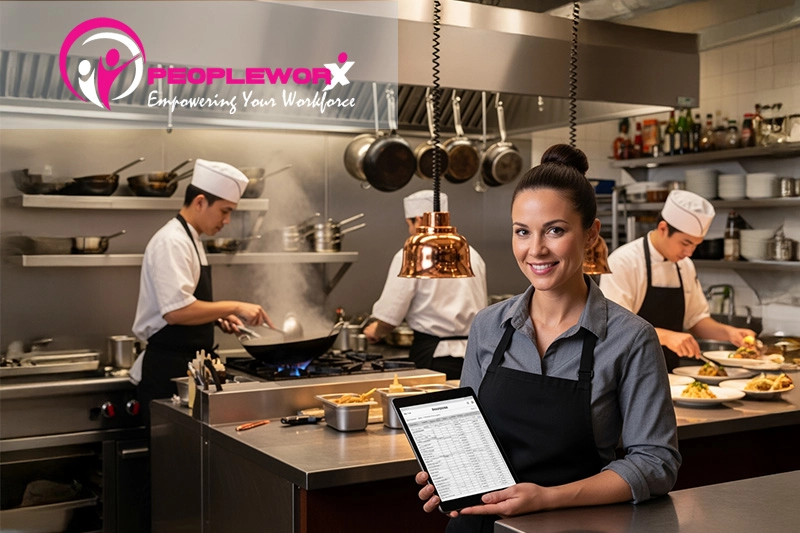
In restaurants, payroll is often treated as an administrative function that happens at the end of the week or the end of the pay period. Hours are approved, tips are reviewed, corrections are made, and payroll is run. On paper, that sounds straightforward. In reality, restaurant payroll is rarely clean, linear, or isolated from the rest of the business.
That is because payroll in a restaurant is not simply a finance process. It is a reflection of how the business schedules labor, tracks time, manages tips, handles onboarding, trains managers, and communicates with employees. When those pieces are disconnected, payroll becomes the place where every operational inconsistency shows up at once.
This is why payroll problems in restaurants tend to carry a bigger impact than leaders initially expect. They do not just create extra work in the back office. They erode employee trust, consume manager time, introduce wage-and-hour risk, and create friction that can be difficult to absorb in a business already running on narrow margins. Federal requirements around overtime, recordkeeping, tip treatment, and employment verification add another layer of complexity, especially for operators managing multiple locations or high employee turnover.
The restaurants that handle payroll well usually are not the ones with the fewest variables. They are the ones that understand payroll as part of a larger workforce strategy. They recognize that accurate pay, consistent processes, and well-trained managers are not just compliance matters. They are foundational to retention, culture, and operational stability.
Content
- Why restaurant payroll gets complicated so quickly
- The real cost of payroll mistakes in a restaurant environment
- Tips are one of the biggest pressure points
- Overtime problems often begin long before payroll is processed
- Onboarding speed creates hidden payroll risk
- Manual work creates administrative drag leaders underestimate
- What strong restaurant payroll processes tend to have in common
- Why this belongs in an HR conversation
- Final thought
- FAQs: Restaurant Payroll, HR Risk, and Compliance
Why restaurant payroll gets complicated so quickly
Every industry has payroll demands, but restaurants face a unique concentration of variables. Schedules change constantly. Employees pick up shifts, trade shifts, or work across roles. Managers are making real-time decisions to cover service needs. Tipped employees may receive cash tips, charged tips, or pooled tips. New hires enter the organization quickly, often under time pressure. By the time payroll is processed, the pay period may already reflect dozens of small decisions that were never documented with payroll in mind.
That matters because payroll accuracy depends on what happens upstream. If timekeeping is inconsistent, payroll inherits those inaccuracies. If managers do not understand overtime rules, payroll inherits that exposure. If tip reporting lacks a clear process, payroll becomes the cleanup point for confusion that should have been addressed much earlier.
The IRS makes clear that employers have multiple obligations related to employee tip income, including recordkeeping, withholding, reporting, and tax deposit responsibilities. The Department of Labor also outlines specific rules for tipped employees under the Fair Labor Standards Act, including how tip credits may apply under federal law. These are not abstract compliance issues for restaurants; they are daily operational realities.
In other words, the complexity is not caused by payroll software alone, nor is it solved by payroll software alone. The real challenge is that restaurant payroll sits at the intersection of operations, compliance, and employee experience.

Need Payroll?
Learn how PeopleWorX helps restaurants like yours handle payroll with dedicated support.
Learn more here →The real cost of payroll mistakes in a restaurant environment
When leaders think about payroll errors, they often think first about reprocessing time, voided checks, or administrative inconvenience. Those costs are real, but they are usually not the most significant ones.
The greater cost is often trust.
Employees in restaurants rely on pay consistency in a very immediate way. Many are living close to paycheck to paycheck. A missed hour, an overtime miscalculation, or confusion about tips does not feel like a minor clerical issue to them. It feels personal. And when those mistakes happen more than once, employees start to lose confidence not only in payroll, but in management.
This matters in an industry where turnover is already high and frontline stability is hard won. A restaurant can spend heavily on recruiting, onboarding, and training, only to create avoidable dissatisfaction because its pay practices feel inconsistent or opaque. Even when the underlying issue is unintentional, the employee experience is the same: they worked, and the pay experience created doubt.
There is also the cost of distraction. Every payroll issue that needs to be manually investigated takes time from managers, operators, and HR teams. In a single-location business, that may mean one owner spending hours each pay period checking timesheets and answering employee questions. In a multi-location operation, it can become a constant cycle of exception handling that prevents leaders from focusing on staffing, service, and performance.
This is where payroll stops being a transactional function and becomes a leadership issue.

Tips are one of the biggest pressure points
Few areas create more confusion in restaurant payroll than tip handling. Not because operators are indifferent, but because the rules, workflows, and day-to-day realities can be difficult to align perfectly.
The IRS states that employers have responsibilities around employee tip income that include recordkeeping and reporting, retaining employee tip reports, withholding taxes based on wages and tip income, and paying or depositing those taxes. Employees also must include tips in gross income, including direct tips, charged tips paid by the employer, and amounts received through valid tip-pooling or tip-splitting arrangements.
For restaurants, that means tip handling cannot live in an informal gray area. It needs structure. It needs a consistent method for recording tip income, a clear understanding of who is responsible for review, and a process employees can trust.
The operational challenge is that tips are often where the messiness of restaurant work becomes most visible. A shift may begin understaffed, roles may change midstream, and gratuities may come through different channels. If the process for recording and reconciling those amounts is not tight, payroll becomes dependent on memory, manual correction, or post-payroll explanation. That is not sustainable, and it certainly does not inspire confidence.
The most effective operators do not treat tip compliance as a technicality. They treat it as a process discipline issue. The question is not simply whether tip amounts are entered. The question is whether the business has a reliable, repeatable system that reduces ambiguity for both management and employees.

Overtime problems often begin long before payroll is processed
Many restaurant leaders assume overtime issues happen inside payroll. More often, they begin during scheduling or shift management.
A manager asks someone to stay late. Two employees swap coverage. A worker clocks in under one role but performs another. Someone forgets to punch out. Hours are adjusted manually after the fact. These all feel like ordinary operating events, but each one has payroll implications.
Under the Fair Labor Standards Act, covered nonexempt employees generally must receive overtime pay for hours worked over 40 in a workweek, at not less than one and one-half times the employee’s regular rate of pay. The Department of Labor also notes that the workweek is a fixed and regularly recurring period of 168 hours, and overtime is calculated on a workweek basis, not by pay period or by day.
That distinction matters. Restaurant managers are often making staffing decisions based on immediate service needs, not on how total hours will aggregate by the end of the workweek. Without strong visibility and discipline, overtime becomes easy to miss until it has already happened.
This is one reason payroll accuracy depends so heavily on manager training. If front-line supervisors do not understand how labor rules work in practice, payroll teams end up correcting problems they did not create. That is not a payroll weakness; it is an organizational design issue.
The strongest operators know that wage-and-hour compliance is not owned by payroll alone. It is shared by every person making staffing decisions.

Onboarding speed creates hidden payroll risk
Restaurants often hire quickly because they have to. Open shifts need to be covered. Seasonal demand spikes. Managers want new employees on the floor as soon as possible. But speed introduces risk when onboarding processes are fragmented or inconsistent.
USCIS requires employers to use Form I-9 to verify the identity and employment authorization of individuals hired for employment in the United States. Employers must complete and sign Section 2 of Form I-9 within three business days of the employee’s first day of work for pay.
For restaurant operators, this is where payroll and HR are tightly linked. If onboarding documents are late, if tax information is incomplete, or if employee setup happens in disconnected systems, payroll accuracy often suffers. The employee may still begin work, but the administrative foundation behind that employment relationship is unstable.
And when onboarding is rushed repeatedly, that instability compounds. Teams spend time chasing signatures, correcting records, and fixing pay setup instead of building a clean and compliant hiring process from the start.
This is one of the clearest examples of why payroll should not be thought of in isolation. A restaurant may believe it has a payroll issue when it actually has an onboarding workflow issue. Solving the symptom without addressing the cause rarely produces lasting improvement.
Manual work creates administrative drag leaders underestimate
Some payroll friction is obvious. Some of it hides in routine.
A spreadsheet here. A text message about a missed punch there. A manager emailing an adjustment. A location sending tip details in a separate file. One correction on its own feels manageable. The problem is accumulation.
Manual work tends to become normalized in restaurant environments because leaders are used to operating fast. They get good at patching around broken processes. But the longer that pattern continues, the more payroll becomes dependent on human memory, extra reconciliation, and last-minute cleanup.
That creates two problems. First, it increases the chance of error. Second, it institutionalizes inefficiency.
The real danger is not simply that manual work takes time. It is that it hides the need for a better process. Teams can become so accustomed to fixing payroll every cycle that they stop questioning why the same fixes are needed at all.
For growing restaurants, this becomes especially costly. What feels manageable in one location often becomes unmanageable in three, five, or ten. At that point, leaders are not just dealing with payroll administration. They are dealing with inconsistent labor practices across managers and sites.
What strong restaurant payroll processes tend to have in common
The best restaurant payroll operations do not necessarily look flashy from the outside. In many cases, they look quiet. Fewer surprises. Fewer corrections. Fewer employee questions. Less tension between managers and administration.
That kind of stability usually comes from a few underlying disciplines.
First, time data enters payroll through a consistent process rather than through multiple ad hoc channels. Second, there is clarity around how tips are recorded, reviewed, and reconciled. Third, managers understand the labor implications of scheduling and approvals, not just the operational ones. Fourth, onboarding is connected to payroll setup rather than treated as a separate administrative event. Fifth, exceptions are reviewed before payroll is finalized, not after employees are paid incorrectly.
None of that is especially glamorous, but it is exactly where maturity shows.
Restaurant operators sometimes look for a single “fix” to payroll pain. In practice, the stronger solution is usually more structural. It is the alignment of systems, manager accountability, documentation practices, and HR oversight.
That is also where businesses begin to move from reactive administration to proactive workforce management.
For leaders looking at payroll issues and wondering whether they point to broader people-process concerns, this is often the right time to step back and look at the bigger HR picture, not just the paycheck itself.
Why this belongs in an HR conversation
A restaurant can run payroll every cycle and still have a weak people infrastructure.
That may sound counterintuitive, but it is common. Payroll gets done, employees get paid, and yet the underlying process is still creating stress, risk, and dissatisfaction. When that happens, the problem is no longer “Can we process payroll?” The problem becomes “Are we managing the workforce in a way that supports compliance, trust, and growth?”
That is an HR question.
HR, at its best, is not only about policies and handbooks. It is about creating the structure that allows the employment relationship to function well. That includes onboarding, documentation, communication, manager training, consistency, and employee confidence. Payroll sits within that ecosystem whether organizations recognize it or not.
This is why restaurants that want to reduce payroll friction often benefit from evaluating the broader systems around it. The answer may be partly technological, but it is also procedural and managerial. Better payroll outcomes usually follow better workforce processes.
A useful next step for many employers is simply getting clearer on where those gaps exist and where risk is beginning to build. That is where educational HR resources can be valuable, especially for operators trying to strengthen processes without turning every challenge into a vendor conversation.
Final thought
Restaurant payroll is often described as complicated because of tips, overtime, and turnover. That is true, but it does not tell the whole story. The deeper issue is that payroll reflects the quality of the systems around it. If scheduling is inconsistent, if onboarding is rushed, if managers are undertrained, or if documentation is scattered, payroll will absorb the consequences.
That is why the most effective restaurant operators do not treat payroll as a narrow administrative task. They treat it as a business-critical function tied to risk management, employee trust, and operational discipline.
When payroll is handled well, employees notice. Managers feel the difference. Administrative friction decreases. Confidence goes up. And the business gains something every restaurant needs more of: consistency.
FAQs: Restaurant Payroll, HR Risk, and Compliance
Why is restaurant payroll more difficult than payroll in many other industries?
Restaurant payroll tends to be more complex because it combines variable schedules, tipped wages, overtime exposure, frequent shift changes, and ongoing hiring activity. Those moving parts create more opportunities for inconsistencies in timekeeping, pay calculation, reporting, and documentation. Federal requirements around tips, overtime, and employment verification add another layer of complexity that operators need to manage carefully.
Why do payroll issues in restaurants so often become HR issues?
Because payroll affects more than pay. It affects employee trust, manager workload, onboarding quality, documentation practices, and overall consistency in the employment relationship. When pay is wrong or unclear, employees feel it immediately. Repeated issues can hurt morale and retention, while also signaling deeper process problems in scheduling, supervision, or HR administration.
What should restaurant leaders understand about tip reporting?
Restaurant leaders should understand that tip income is not informal income from a compliance standpoint. The IRS requires employers to meet recordkeeping and reporting obligations related to employee tip income, including withholding and tax deposit responsibilities. Employees must also report tip income, including direct tips, charged tips, and shares received through tip-pooling or tip-splitting arrangements. That is why restaurants need a clear and repeatable tip documentation process, not just a loose end-of-shift routine.
Where do overtime problems usually start?
Overtime issues often start on the operations side, not during payroll processing itself. Last-minute scheduling decisions, shift extensions, missed punches, job changes, and manual edits can all affect overtime calculations. Under the Fair Labor Standards Act, covered nonexempt employees generally must receive overtime pay for hours worked over 40 in a workweek, so managers need to understand how day-to-day staffing choices affect labor compliance.
Why is onboarding so closely tied to payroll accuracy?
Because onboarding establishes the information payroll depends on. If employment verification, tax documents, pay setup, or employee records are incomplete or delayed, payroll often becomes the place where those gaps surface. USCIS requires employers to use Form I-9 for new hires and to complete Section 2 within three business days of the employee’s first day of work for pay. In fast-moving restaurant environments, that makes a structured onboarding process especially important.
What are signs that a restaurant’s payroll process needs attention?
Common signs include repeated manual adjustments, frequent employee questions about pay, confusion around tips, avoidable overtime surprises, delayed onboarding paperwork, and managers spending too much time resolving payroll issues after the fact. Those signs usually point to broader process weaknesses rather than a one-time payroll problem.
Is better payroll mostly about better software?
Not entirely. Technology can help reduce manual work and improve visibility, but stronger restaurant payroll outcomes usually come from a combination of better systems, clearer workflows, stronger documentation, and manager accountability. Software may support the process, but it does not replace process discipline.
When should a restaurant step back and evaluate broader HR risk?
Usually when payroll problems become repetitive rather than occasional. If the same issues keep resurfacing across pay periods, locations, or managers, that is often a sign the organization needs to evaluate its broader HR and workforce processes. Payroll errors are often symptoms of larger issues in onboarding, scheduling, compliance, or people management.
If you need help with workforce management, please contact PeopleWorX at 240-699-0060 | 1-888-929-2729 or email us at HR@peopleworx.io